

The most well-known historical episode of resource scarcity occurred in Egypt during the time of Prophet Yusuf (peace be upon him). The King of Egypt had a dream in which seven fat cows were devoured by seven skinny ones, and seven green ears of corn were accompanied by seven dry ones (The Quran, 12:43-49). This dream symbolized seven years of abundance, followed by seven years of drought and famine.
The plan that Prophet Yusuf devised for the King is a textbook example of managing scarce resources. This episode demonstrates that such challenges cannot be addressed primarily by market forces or individual free choice. Why?
Facing the threat of starvation, everyone will strive to hoard as much grain and water as possible to survive the famine. But if each followed the same strategy, society would run out of resources even before the famine. The members will create their own famine for their selfish motives. This is known as the “Tragedy of the Commons.” It is a tragedy because, with selfish motives, the members cause their own crises. Had they been able to coordinate their utilization of resources, they would have all survived.
The conflict between individual and collective interests is generally known as “Social Dilemmas.” The two worst crises in modern history, the Global Financial Crisis and the Climate Change Crisis, arise from the conflict between individual interest and collective good.
Standard (neoclassical) economics has one, and only one, answer to Social Dilemmas: A selfish choice is the dominant strategy that should be followed by “rational agents.” In other words, the “tragedy” is inevitable. No wonder that economics was dubbed the “dismal science.”

Of course, being rational does not mean being selfish. The utmost form of rationality is to consider both individual and collective interests. This requires a mechanism to coordinate the collective consumption of scarce resources. The plan of Prophet Yusuf (peace be upon him) managed to balance the savings of grain during the years of abundance so it could be gradually consumed until the end of the famine.
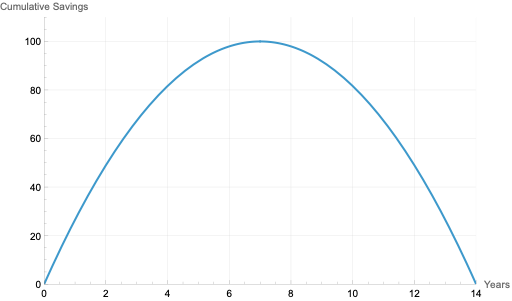
We do not have full details on how Prophet Yusuf managed the grain allocation for the entire period. However, a simple optimization model shows that, ideally, cumulative savings should follow an inverted parabola (Figure 1). The peak of the curve is at year 7 when abundance ends. From then on, savings are gradually consumed until the end of the famine.

An optimal plan would result in a smooth rate of change in savings. Again, a simple optimization model would result in a rate at which the savings are used that remains constant, ensuring that the supply lasts until the abundance returns (Figure 2). This careful balance avoids waste and shortage, showing the wisdom behind Prophet Yusuf’s strategy of measured and planned distribution.
However, Prophet Yusuf’s approach was not purely centralized. We learn from the Quran that those who sought support from the King had to offer some goods (بضاعة) in exchange for the grain (The Quran, 12:65, 88).
The exact mechanism is not clear, but it is clear that the grain was not provided as a pure transfer or grant. There must be a kind of exchange. The value of the exchanged goods was probably not equivalent to the value of the grain received during the famine. However, this requirement served as a mechanism for managing incentives and introducing discipline into the distribution system. In this way, Prophet Yusuf implemented what could be called a “blended system” to manage scarce resources.
A blended approach to managing resources strikes a balance between public and private mechanisms. The success of such a mechanism requires two critical factors:
The work of Nobel laureates Elinor Ostrom and Alvin Roth shows how innovative mechanisms can overcome social dilemmas and fruitfully harmonize incentives and social responsibility. Both laureates show that social dilemmas-where individual rationality can undermine collective welfare-can be addressed by carefully designed mechanisms. These mechanisms align incentives and values, fostering cooperation and producing outcomes that benefit both individuals and society as a whole.
This field is now known as “mechanism design.” It is a ripe area for creativity and innovation. There is no one-size-fits-all solution to social dilemmas. Wisdom and careful design are necessary to create a blended system that balances individual incentives with collective moral responsibility.
As the famous Serenity Prayer says: “God, grant me the serenity to accept the things I cannot change, courage to change the things I can, and wisdom to know the difference.”
In the context of resource management, this wisdom is essential: knowing which aspects require collective action and regulation and which can be entrusted to individual or market forces.
With this perspective, economics would be the “science of wisdom” rather than the “dismal science”!



Dr. Ghazi Abdul Rahman Al-Gosaibi (1940-2010) was a prominent figure in Saudi Arabia and throughout the Arab world. As a...
ReadNobel laureate Joseph Stiglitz once remarked that debt financing without bankruptcy is like Hamlet without the Prince. Or, to borrow...
Readهذه المقالة مترجمة عن الإنجليزية لمدونة إلكترونية بعنوان: Is Riba Sustainable ? ترجمة: د. محمود بكريالربا (أو الفائدة) ظاهرة موجودة...
قراءة المزيد