

The global economy is entering a new and more uncertain era. After enduring the shocks of the pandemic, supply chain disruptions, and volatile financial markets, the world now faces risks that extend far beyond the normal business cycle. Geopolitical risk, the possibility that political tensions, conflicts, or diplomatic frictions disrupt economic activity, and geoeconomic fragmentation, the breakdown of global cooperation into competing blocs, have become defining features of today’s international landscape.
These forces are reshaping the very architecture of globalization. Trade, finance, and technology are increasingly being redrawn along political lines, as illustrated in Figures 1.1 and 1.2. The economic and political ties between the world’s main blocs are weakening, leading to a more divided and uncertain global order.
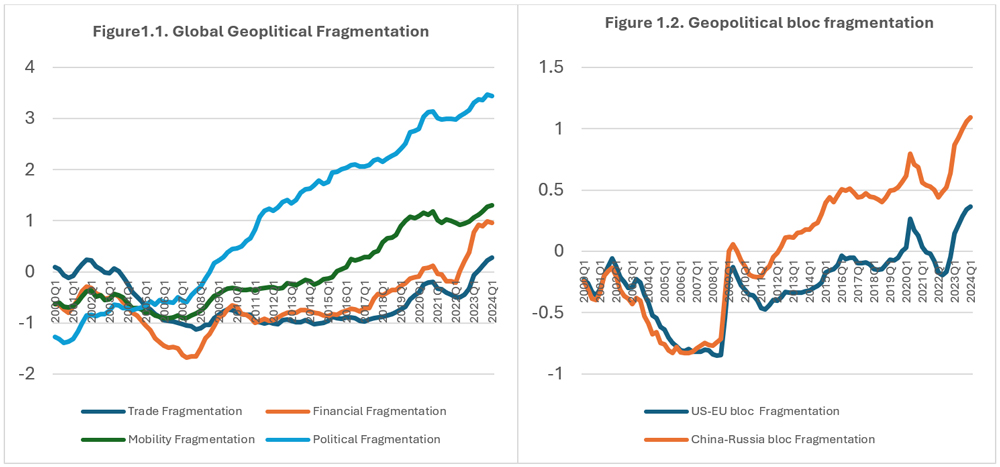
Geopolitical tensions and trade wars are accelerating this shift. They are redrawing global value chains, weakening multilateral systems, and eroding trust among nations. For developing and emerging economies, including many IsDB member countries (MCs), these disruptions have far-reaching consequences. High debt burdens, tighter liquidity, and rising borrowing costs are putting pressure on public finances, while political uncertainty, from prolonged conflicts to abrupt electoral shift, continues to erode investors, business, and consumer confidence.
For IsDB member countries, global integration has long been a key pathway to growth and resilience. Yet, in this new age of instability, policymakers face a dual challenge: preserving short-term macroeconomic stability while laying the foundations for long-term resilience and sustainable growth.
Understanding and addressing geopolitical fragmentation is central to shaping the future of development. The World Trade Organization recently revised its 2026 outlook sharply downward, from an expected 1.8% to a 0.5% expansion in global trade, underscoring the fragility of the global trading system. The IMF in its April 2025 World Economic Outlook report highlighted potential negative hits from tariffs and other policy actions ranging from 0.4% to 1% of world GDP by 2027 due to deepening fragmentation, while a World Economic Forum scenario suggests that if current trends persist, the global economy could lose up to $5.7 trillion, around 5% of output, within just two years. Such a shock would exceed the economic toll of both the 2008 financial crisis and the COVID-19 pandemic.
For policymakers, businesses, and development institutions alike, addressing fragmentation is an economic imperative. It is about safeguarding growth, preserving financial stability, and ensuring that the world’s most vulnerable economies are not left behind in an era of shifting alliances and rising uncertainty.
Pathways of Geopolitical Risk: Transmission and Impact
The effects of geopolitical risk spread through three main transmission channels, each interacting to weaken growth and confidence.
1. Business Confidence
Firms depend on predictability to plan investments and expand operations. When geopolitical uncertainty spike, due to sanctions, trade disputes, or conflict, business leaders adopt a “wait-and-see” approach. This hesitation reduces capital formation and hiring, slowing growth. Evidence from the Geopolitical Risk Index and OECD Business Confidence Index (Figures 2) confirm that surges in geopolitical tension consistently depress business confidence worldwide.

Indeed, firms depend on predictability to invest, plan, and expand. When tensions escalate, through sanctions, trade disputes, or conflict, uncertainty triggers hesitation. Leaders often choose to “wait and see,” postponing investment and hiring until the outlook stabilizes.
More than that, companies are rethinking their strategies altogether. Instead of expanding abroad, many are channeling resources into local or regional markets, where supply chains feel more secure and risks are easier to manage. This inward shift may reduce exposure to global shocks, but it also signals a retreat from globalization and a loss of efficiency. Combined with falling confidence, it slows capital formation, curbs job creation, and undermines long-term growth.
2. Consumer Sentiment
Households react to uncertainty much like firms do. When risks are high, consumers worry about inflation, job security, and rising living costs. Precautionary saving increases while consumption declines, weakening demand at a time when economies need it most. Data from OECD shows that consumer confidence dips sharply during episodes of geopolitical tension, particularly in import-dependent economies.

Consumer confidence tends also to fall when risks are high, as families worry about inflation and job. Figure 3 shows that consumer confidence is negatively impacted by increasing geopolitical risks, and this is particularly apparent during the recent escalation of risks due to the trade dispute between major global economic powers.
3. Structural Fragmentation
Beyond short-term sentiment, geopolitical fragmentation is redrawing the global economic map. Supply chains are being shortened, foreign direct investment (FDI) is being redirected toward “trusted” jurisdictions, and technological decoupling in digital platforms and standards threatens innovation spillovers. For export-oriented developing economies, these shifts mean higher costs and lower competitiveness. According to UNCTAD, cross-border FDI flows in developing regions have declined by over 15% since 2021, reflecting growing caution in a fragmented world.

As is shown in Figure 4 foreign direct investment is becoming more cautious, increasingly concentrated in “trusted” jurisdictions, while global value chains are being shortened or reconfigured to reduce exposure to geopolitical shocks. This realignment raises costs, reduces efficiency, and diminishes the competitiveness of export-dependent economies. At the same time, technological decoupling, in areas such as digital platforms, data flows, and standards threatens to limit innovation spillovers and fragment the very foundations of global knowledge exchange.
Finally, the financial channel adds a further layer of vulnerability. As risk perceptions increase, investors demand higher premiums, pushing up borrowing costs for governments and firms. For countries already carrying high levels of debt, this raises the risk of debt distress and complicates efforts to roll over existing liabilities.
Implications for IsDB MCs
For many member country economies, today’s global dynamics pose particularly acute challenges. Their growth models often rely heavily on foreign direct investment and deep integration into global value chains. This makes them especially vulnerable when fragmentation disrupts trade routes, redirects capital flows, or slows the transfer of technology. At the same time, weak social safety nets mean that even small external shocks can quickly erode consumer confidence. When prices rise or jobs become uncertain, households are forced to cut back, and optimism gives way to anxiety. Adding to this pressure, high levels of public debt leave governments with limited room to maneuver. Just when countries most need fiscal space to shield households and support businesses, they find themselves facing rising borrowing costs and tougher financing conditions.
And yet, amid these headwinds, fragmentation also creates new openings. It is precisely in times of global turbulence that regional solidarity and cooperation can make the greatest difference. By strengthening intra-MCs trade, investing in regional connectivity, and deepening South-South cooperation, member countries can reduce their dependence on volatile global flows.
Such strategies not only anchor confidence within regional markets but also give businesses and households alike a greater sense of security. In this way, regional integration can become more than an economic policy, it can be a pathway toward resilience, opportunity, and shared prosperity in an uncertain world.
Leveraging Islamic Finance for Stability
In today’s fragmented world, where uncertainty often overshadows trust, Islamic finance offers more than financial instruments; it offers a value system grounded in fairness, shared responsibility, and social solidarity. These principles make it uniquely suited to help countries navigate volatility while keeping people at the center of development.
Sukuk for instance provides governments with a practical way to finance sustainable infrastructure while maintaining debt sustainability. Countries such as Indonesia and Malaysia have demonstrated how Sukuk can mobilize global investors seeking ethical, stable, and impact-driven assets.
At the same time, Waqf can play a transformative role in supporting vulnerable communities. When managed transparently, they can bridge humanitarian and development needs, fund social programs, and strengthen community resilience.
By integrating these Islamic finance tools into broader macroeconomic strategies, member countries can mobilize sustainable capital, enhance social protection, and build trust in national institutions.
Conclusion
The link between geopolitical risk and business confidence is real and immediate. When tensions rise, uncertainty spread, businesses delay investments, consumers cut back spending, and financial markets tighten. Over time, this uncertainty slows growth and deepens vulnerabilities, especially in economies that already face structural challenges. Yet, this moment also offers a chance for renewal. With the right policies, countries can turn today’s turbulence into a platform for stronger, more inclusive, and more sustainable growth.
To navigate this shifting global landscape, policymakers should focus on five priorities:


